KarmaVaani

History

धर्म का इतिहास

How the tradition unfolded

Slide through twelve eras, from the first farmers of Mehrgarh to temples on every continent. The globe turns to where each age was centred, and each is told twice: as the tradition remembers it, and as historians read the evidence.

When each idea first appearsThe scriptures, as a tree

Two ways of telling one story

In the tradition

Within the tradition, Sanatana Dharma has no beginning. The Vedas are apaurusheya, not composed by any person: the rishis heard them in deep meditation and handed them down unchanged. Time moves in great cycles of four yugas, and dharma is renewed in each by sages, avatars and saints. Seen this way, history records how an eternal teaching was remembered, not how it was made.

What the evidence shows

Historians work from what survives: the wording of texts, excavated sites, inscriptions and dated coins. They ask when an idea is first visible in that record, which is not the same as when it began, because oral practice leaves no trace. On that evidence the tradition grew in layers over some four thousand years, each age adding to what came before rather than replacing it.

How historians date the past
  • Layers inside a text: the Rigveda's family books (mandalas 2 to 7) are older than its first and tenth books.
  • Words that are missing: the Rigveda knows no rice and no iron, so it predates the texts that do.
  • Inscriptions with dates: the Mitanni treaty (c. 1350 BCE) names Vedic gods; Ashoka's edicts (c. 250 BCE) and the Heliodorus pillar (c. 110 BCE) fix later points.
  • Archaeology: Mehrgarh, the Indus cities, Painted Grey Ware sites and the first stone temples give places and dates to what the texts describe.

Timeline explorer

Era 1 of 12c. 7000 – 3300 BCE

Mehrgarh · Balochistan, Sindh, the Deccan and central India

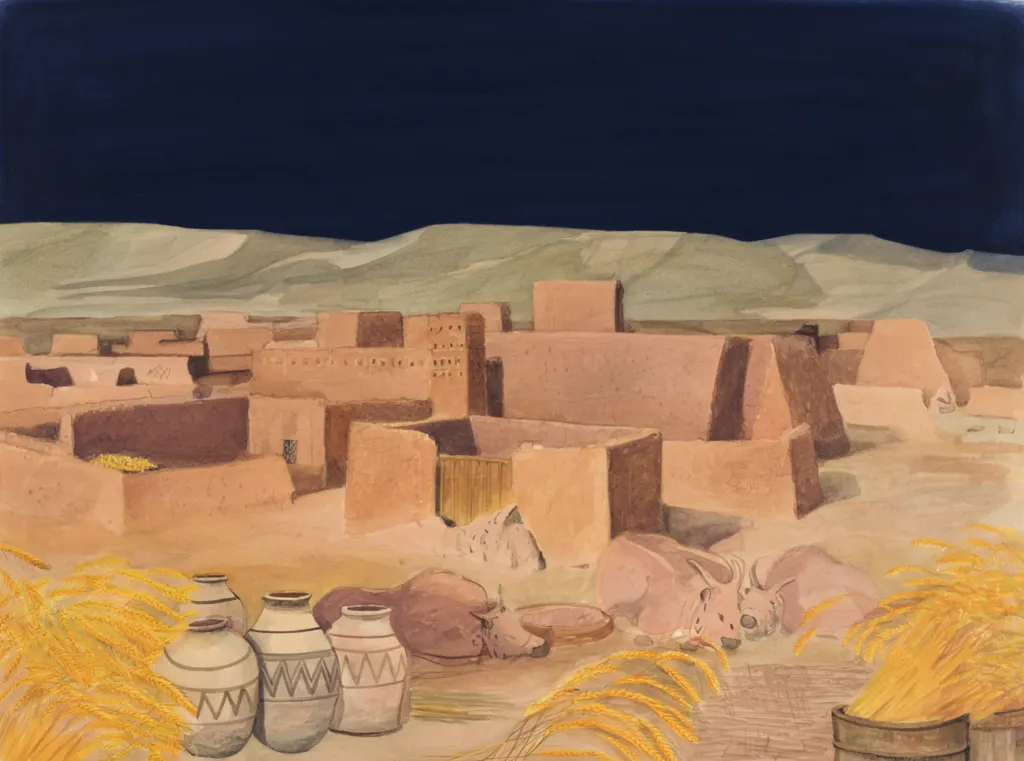
Illustration: A Neolithic mud-brick village at dusk beneath dry hills in Balochistan, painted clay storage jars, sheaves of barley and humped zebu cattle resting nearby

Era 1Majority view

Before the Vedas

Farmers, herders and the ground the tradition grew from

In the tradition

The tradition does not place its beginning in any dated age. The Puranas speak of earlier yugas and of the Sarasvati flowing full, and many families trace their gotra to rishis of an immeasurably old past. The village goddess, the sacred tree and the serpent shrine are honoured as part of the same living dharma, whatever their age.

What the evidence shows

Long before any Vedic hymn, people in South Asia were farming barley and wheat, herding humped zebu cattle and burying their dead with grave goods. At Mehrgarh in Balochistan this way of life is very old, though a 2025 study puts its first farming nearer 5200–4700 BCE than the older estimates. Many scholars think village goddesses, serpent cults and tree worship descend from this substrate rather than from the Vedas.

  • Farming, cattle herding and burial with grave goods predate any Indo-Aryan speakers in South Asia.
  • In the Deccan, ashmounds record centuries of burning cattle dung; whether this was ritual is debated.
  • Local goddesses, nagas and sacred trees plausibly come from this older layer.

Deities: the village and the Goddess

Historical dating adapted from How It Evolved (CC BY 4.0).

All twelve eras

  1. 1. c. 7000 – 3300 BCE · Mehrgarh

    Before the Vedas

    Long before any Vedic hymn, people in South Asia were farming barley and wheat, herding humped zebu cattle and burying their dead with grave goods.

  2. 2. c. 3300 – 1300 BCE · Mohenjo-daro and Harappa

    The Indus Civilization

    The Indus script survives on about four thousand objects and is still undeciphered, so everything said about Harappan religion is inference.

  3. 3. c. 1500 – 1200 BCE · Sapta Sindhu

    The Oral Rigveda

    The Rigveda's hymns were composed and memorised without writing and passed on with astonishing accuracy for about a thousand years.

    First seen: Rta, the cosmic order (c. 1400 BCE); Doubt voiced in scripture (c. 1100 BCE); The four varnas named (c. 1100 BCE).

  4. 4. c. 1200 – 900 BCE · Kuru-Panchala

    Late Vedic

    Between about 1200 and 900 BCE the centre of Vedic life moved east from the Punjab into the Ganga–Yamuna doab.

    First seen: Iron (c. 1200 BCE); Rice (c. 1100 BCE); "Namah Shivaya" (c. 1000 BCE); Ritual that moves the cosmos (c. 900 BCE).

  5. 5. c. 900 – 500 BCE · Videha and Kosala

    The Upanishadic Turn

    Karma as moral cause, rebirth, liberation and the identity of the Self with the absolute first appear in texts of about 700–500 BCE.

    First seen: Karma as moral causation (c. 700 BCE); Rebirth, samsara (c. 700 BCE); Moksha, liberation as the goal (c. 700 BCE); Atman is Brahman (c. 700 BCE).

  6. 6. c. 600 – 200 BCE · Magadha

    The Shramana Challenge

    Buddhists, Jains and Ajivikas accepted karma and rebirth but rejected the Veda, animal sacrifice and the authority of brahmins.

    First seen: Ahimsa as a supreme value (c. 500 BCE); Renunciation as an institution (c. 500 BCE); Writing (c. 250 BCE); Vegetarianism as an ideal (c. 250 BCE).

  7. 7. c. 200 BCE – 300 CE · Mathura and Vidisha

    Epic and Classical Synthesis

    Image worship, temples, bhakti and the avatar doctrine all first become visible between about 200 BCE and 300 CE.

    First seen: Bhakti, devotion, attested (c. 110 BCE); Avatara, God takes birth (c. 1 CE); The sacred image, murti (c. 50 CE); Manu's law book (c. 50 CE).

  8. 8. c. 300 – 650 CE · Udayagiri and Deogarh

    Puranic Hinduism

    Between about 300 and 650 CE the stone temple, image worship, pilgrimage and the festival calendar took the shape they still have.

    First seen: The stone temple (c. 400 CE); Tantra in writing (c. 500 CE); The supreme Goddess (c. 575 CE).

  9. 9. c. 650 – 1200 CE · Thanjavur and the Kaveri delta

    Bhakti and the Regional Turn

    Tamil poet-saints made devotion in a spoken language a path to God open to women and outcastes.

    First seen: Advaita as a system (c. 725 CE); Scripture in Tamil (c. 750 CE); The Brihadisvara temple (c. 1010 CE).

  10. 10. c. 1200 – 1750 CE · Banaras and the Sant country

    The Sant Age

    From about 1200 to 1750 bhakti moved fully into regional languages, and 'Hindu' began to be used as a religious self-description in contrast to 'Turk'.

    First seen: "Hindu" as self-description (c. 1350 CE); Scripture in Awadhi (1574 CE).

  11. 11. c. 1750 – 1947 CE · Calcutta

    Renewal and Reform

    In 1750 there were many sampradayas and no single religion called Hinduism; by 1947 there was one.

    First seen: "Hinduism" as a world religion (1800 CE); All paths lead to one truth (1893 CE).

  12. 12. 1947 – today · Delhi

    Modern and Contemporary

    After 1947 the Indian state became a legislator for Hindu life: Article 17 abolished untouchability and the Hindu Code Bills of 1955–56 rewrote family law.

    First seen: Codified Hindu law (1955 CE).

Era dates, places and dated firsts are adapted from How It Evolved, licensed CC BY 4.0. The wording, and the accounts of the tradition, are KarmaVaani’s own. Where respected traditions and historians differ, both are given rather than resolved.